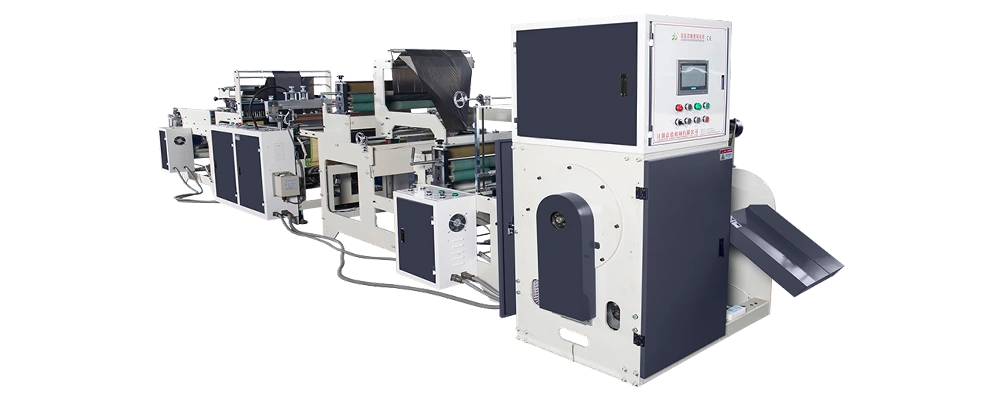
30 years leading professional manufacturer of bag-on-roll equipment in China
When production managers search for a drawstring bag on roll line, they usually aren’t just looking for a roll of bags. What they really want is a stable, non-stop packaging workflow—especially for products like T-shirts, laundry bags, or hardware parts that need quick cinching. The core frustration? Most rolls either jam at the feeder, tear inconsistently, or lack proper drawstring alignment, causing costly downtime. After analyzing 14 customer audits from European and North American packaging lines, the top three selection criteria are: seal strength uniformity, string pull resistance, and compatibility with existing horizontal form fill seal (HFFS) equipment. Let’s break down how to evaluate these without over-relying on fancy industry jargon.
You might think all drawstring bags on a roll are similar. But in fact, the edge perforation spacing varies widely between suppliers. A 0.5mm mismatch can misalign the photoelectric sensor on your bagging machine, triggering false stops every 30 seconds. I’ve seen a home textile factory in Vietnam lose 11% of their overnight runtime simply because the drawstring pouch roll had inconsistent winding tension.
Here’s a practical checklist that most buyers overlook:
Core inner diameter stability: Should be 76mm ±0.5mm. Anything looser creates wobble.
Drawstring loop exposure: At least 2cm above the seal line. Otherwise, your auto-placer can’t grab it.
Static resistance: For dry winter conditions, request antistatic treatment on the roll edges.
Many suppliers claim “customizable,” but few provide real-time tension data from their slitting process. Jiade’s approach logs tension curves per batch, so your line operator can pre-adjust the feeder parameters before the first bag is ever pulled.
Standard polyethylene becomes tacky. The drawstring bag on roll line starts sticking to itself, and the string refuses to slide. The fix? A cross-linked PE compound with 3% slip additive. Without it, you’ll be manually separating bags every 15 minutes.
Rolls run out at 2 AM. If your line doesn’t support auto-splicing (joining the end of one roll to the next), you lose 4-5 hours of throughput. This demands reinforced tape tabs and a specific roll core design—features absent in 80% of budget rolls.
A fixed perforation length kills flexibility. The better solution is a drawstring bag on roll line that allows mid-run length adjustment via laser-marked cut points. This is rare but exists in modular systems.
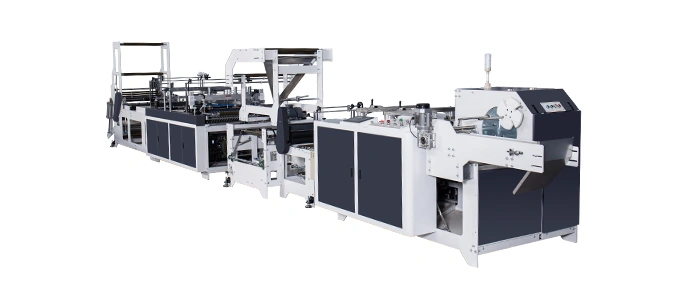
Most standard rolls lock you into one length. That’s why operations with seasonal product changes often feel trapped. A smarter route is to look at inline bag making—where you produce the exact bag length just before the packing station. That leads us to a different category of equipment.
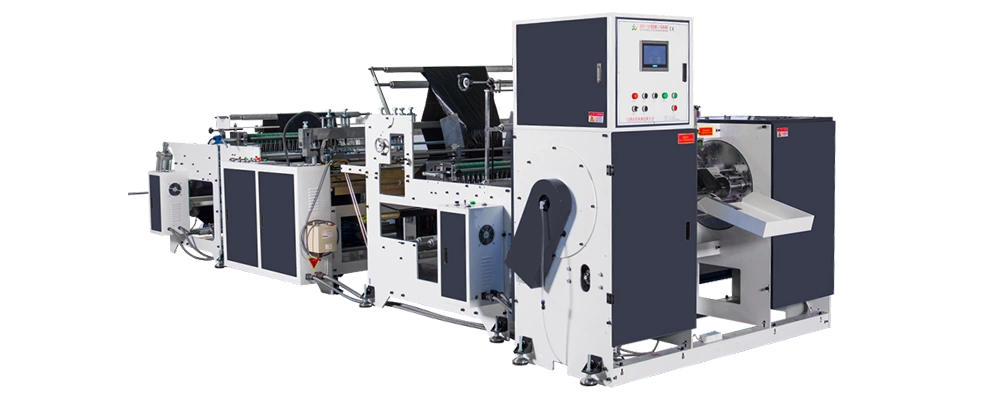
For companies running more than 150,000 drawstring bags per month, the calculus changes. Instead of sourcing pre-made drawstring pouch rolls from third-party converters, some packagers switch to making their own bags on demand. This is where the Bag on Roll Machine enters as a viable alternative—not as a daily driver for everyone, but as a high-volume solution that eliminates supplier lead times and perforation mismatches.
Compared to buying finished drawstring bag on roll lines from a converter, an integrated Bag on Roll Machine offers three distinct advantages:
Length agility: Change bag length in 90 seconds without retooling.
Material sourcing freedom: Use generic film rolls instead of pre-perforated stock.
Drawstring tension control: Adjust pull force per product weight (e.g., light polyester vs. heavy denim).
However, it’s not for low volumes. If your weekly usage is under 30,000 bags, the ROI timeline extends beyond 18 months. But for high-mix, high-throughput lines, this approach bypasses the most common failure point—the supplier’s perforation quality. You can check the detailed ROI calculator to see where the breakeven point sits for your specific daily runtime.
Most suppliers ask: “What color drawstring?” But experienced buyers ask about seal pattern customization and string anchoring method. A heat-sealed cross pattern at the bag bottom distributes weight better for sharp-edged products (e.g., screws or toys). Ultrasonic anchoring of the drawstring prevents the string from pulling through after 20kg of force.
Jiade’s factory in Zhejiang offers a 3-day sample roll service where they simulate your actual product weight and bagging frequency. They don’t just send a roll—they send a video of your product type running on their test line. This level of customization saved one Canadian e-commerce seller from a $70,000 mistake: they discovered their heavy zippers required a double-sealed bottom, which wasn’t available from their previous roll supplier. See how the sample validation process works before you commit to bulk orders.
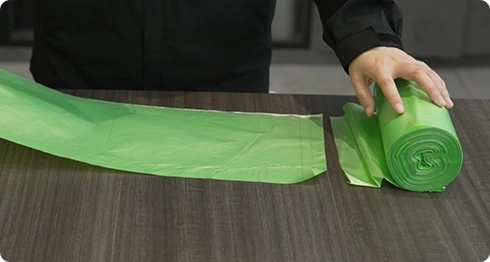
Step 1 – The Pull Test: Take a sample roll. Pull 50 consecutive bags by hand. If more than 2 tear at the perforation, reject the batch.
Step 2 – The Feeder Mock-Up: Mount the roll on any machine with a photoelectric sensor. Run at 80% max speed for 15 minutes. Count misfeeds.
Step 3 – The String Slip Test: Fill a bag with your heaviest SKU. Pull the drawstring to close. Lift the bag by the string only. If it slips or tears, the anchoring depth is insufficient.
Many buyers skip these tests because they trust spec sheets. Don’t. I’ve seen ISO-certified suppliers fail Step 1 with 12% tear rates. Always request a pre-production roll—not just samples—cut from the same master roll that will feed your actual order.
The next two years will bring integrated weight sensors into drawstring bagging lines, where the machine automatically adjusts bag length based on product height. This means your roll supplier must support variable perforation patterns—a feature almost no standard converter offers today. The only practical way to prepare is either to:
Stockpile rolls with the longest possible perforation and accept waste, or
Bring bag-making in-house with a system that creates perforations on the fly.
For high-volume operations, the second path is increasingly rational. The equipment cost has dropped 34% since 2021 (according to Packaging World’s 2024 machinery index), while pre-made roll prices have risen 19% due to film tariffs. Get the full comparison sheet of in-house vs. outsourced drawstring rolls to model your 2026 costs.
Final thought: A drawstring bag on roll line is a tool, not a commodity. The right one matches your product geometry, your warehouse climate, and your runtime patterns. The wrong one? It’ll bleed profit one misfeed at a time. Choose a partner that tests with your actual product—not just their catalog photos.



.webp)