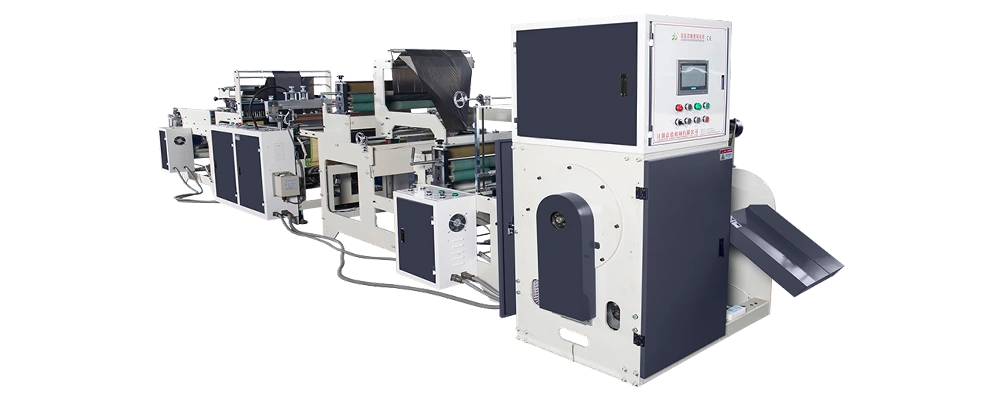
30 years leading professional manufacturer of bag-on-roll equipment in China
Before listing the applications, it helps to understand why a single machine can serve such different markets. The key lies in modular downstream components: interchangeable perforation blades, gusset formers, and independent winding stations. When a converter learns to swap these modules quickly — some designs allow a full changeover in under 15 minutes — the machine’s product range expands significantly. According to feedback from several North American packaging firms, shops that routinely run three or more bag configurations report 22% higher equipment utilization rates than those stuck on a single SKU. With that versatility in mind, let’s look at the five uses that routinely deliver strong returns.
Supermarkets and grocery chains use millions of roll bags every day in the fresh produce section. The most common design is a light-duty HDPE or LDPE bag on a continuous roll, perforated between each bag, with a star-seal bottom for strength. What makes this application technically demanding is the perforation precision. Tear-off needs to be effortless for the consumer — you’ve seen shoppers wrestling with bags that rip diagonally or won’t separate — yet the web must remain intact during high-speed winding. Experienced operators recommend maintaining a perforation land width between 0.4 mm and 0.8 mm for 10–15 micron films. Going below that threshold creates premature tears on the rewinder; above it frustrates end users.
The winding tension profile also matters. A taper tension control, which gradually reduces winding force as the roll diameter increases, prevents telescoping (the infamous cone-shaped roll) and film stretching. If you’re producing rolls longer than 500 bags, a surface-driven winder often outperforms center-winding alone. These operational nuances make food-grade roll bags a staple application that rewards careful parameter tuning.
Think about the janitorial closet in a hospital or a university building. Staff don’t carry individual trash bags loose in a box; they pull them from a compact roll, tear off a liner, and fit it to the bin. This high-volume market requires a different film — typically a blend of recycled and virgin LLDPE — and often a higher gusset for better can conformity. Because institutional liners are thicker, typically 18–30 microns, the sealing parameters shift. The dwell time on the sealing bar needs to increase, and the cooling block must bring the seal down to below the film’s softening point before winding, or the layers will block together.
Converters who succeed in this segment often run the machine with in-line corona treatment if the rolls are destined for printed logos, because untreated film won’t hold ink after a few months of storage. At this point, you might be curious whether a modular machine can handle such different film gauges without a complete rebuild. The answer usually lies in the sealing carriage design.
Beyond the consumer and janitorial spaces, roll bag systems increasingly serve industrial protective packaging. One common product is a long, tubular bag on a roll used to cover elongated items — rolled carpets, textile bolts, metal extrusion profiles. These bags are often made from heavier LDPE or co-extruded films with UV inhibitors if the wrapped items sit outdoors. The machine configuration differs from grocery bag production in two ways: first, the bag length can exceed 2 meters, so the in-feed dancer system needs a longer stroke to buffer the film during the index cycle. Second, many of these applications skip perforation entirely, instead relying on a hot-knife cut that seals the bottom of the previous bag while creating the next bag’s opening.
Operators new to this application frequently underestimate the static build-up on thick film. Without adequate ionization bars before the winding section, the film wanders, causing uneven roll edges. A well-placed static eliminator, coupled with a web guide, can reduce rejected rolls by over 40%, according to data from a converter running these sleeves for a fiberglass manufacturer.
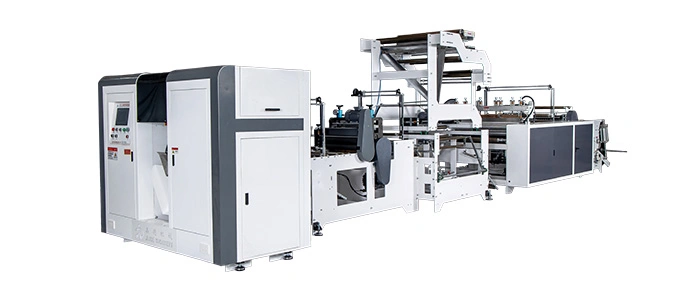
E-commerce fulfillment centers often use roll bags for shipping smaller items: apparel, accessories, books. The bags come pre-opened on one side with a peel-and-seal adhesive strip and are wound on a core. From the machine’s perspective, this application adds a step before winding: the adhesive tape application module. The tape must be applied precisely along the bag’s lip, then covered with a silicone release liner, all while the web moves at speeds up to 60 meters per minute.
The perforation strategy also changes. Because these mailers are often used one at a time and the operator doesn’t want the roll to fall apart inside a packing station, a micro-perforation — sometimes called “skip perforation” with a 2:1 bond-to-cut ratio — keeps the web stable. This prevents a situation where a fast pull by a packer accidentally detaches three bags instead of one. Converters who have tuned these perforation patterns report up to 15% less material waste compared to standard perf settings.
The strictest quality requirements come from the medical sector. Bags intended for biohazard waste, laboratory disposal, or sterilization must meet tensile strength standards and sometimes even pass a dart impact test. These bags are often pigmented — red or yellow — using masterbatch that can alter the film’s sealing window. A machine running this application needs a precise temperature controller on the sealing bar, ideally with a closed-loop feedback system that adjusts heating element duty cycle based on thermocouple readings, not just timers.
Furthermore, some medical bags require printing of batch codes, lot numbers, or biohazard symbols in-line. Print registration on a perforated roll bag production system is demanding because each index motion can create cumulative registration drift. Machines with a servo-driven draw roll and a registration mark sensor can hold tolerances within ±0.5 mm, which is sufficient for ISO 13485 packaging demands. One quality manager at a medical packaging plant noted that the biggest source of rejection was not seal strength but inconsistent print placement — a problem solved by upgrading the infeed tension control rather than the printer itself.
The five uses above share a common thread: they reward converters who think in terms of process flexibility rather than machine brand loyalty. When evaluating a production line for these diverse applications, three operational factors outweigh all others. First, modularity of the perforation and sealing units — can you swap them out in a single-digit minute range, or does each changeover require a maintenance team? Second, the winding technology: does the machine offer independent arm control to handle both thin produce bags and thick industrial sleeves without constant manual tweaking? Third, the control system: recipe-based setups that store parameters for each application reduce reliance on operator memory and significantly cut setup scrap.
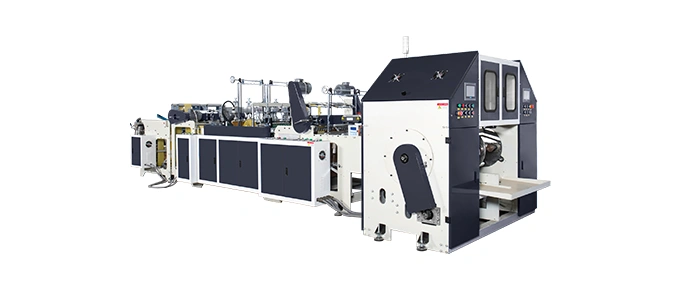
Industry practice shows that converters who systematically document process settings for each of these applications — film tension, sealing temperature, cooling time, perf depth, winder taper — and save them as digital recipes often double their machine’s effective uptime within six months. It’s not about buying a specialized machine for each bag type, but about revealing the versatility already built into a well-designed roll bag system.
If you’re planning to add multiple bag configurations to your production mix, getting a closer look at a modular platform can clarify which features are standard and which require optional add-ons. Specifically, inquire about the perforation changeover mechanism, as this component differentiates a single-purpose line from a truly flexible asset.
A final caution from the field: when a machine runs five completely different products, the temptation is to push every setting to its limit in the name of throughput. With bag on roll making machines, the most expensive speed-related failure isn’t a machine breakdown — it’s a silent quality drift that produces thousands of bags the customer later rejects. Two proactive habits mitigate this risk. First, schedule a 10-minute quality checkpoint at the start of each new roll, not just at shift change. Check perforation tear force with a simple spring gauge; if it drifts by more than 20%, pause and recalibrate. Second, keep a log of seal appearance under a magnifier. Micro-voids in the seal area often precede a full separation failure and can be caught early.
For converters ready to expand their product portfolio without adding floor space, the starting point is a candid audit of current changeover times and rejection rates. Juxtapose those numbers against the potential margins in medical, industrial, or high-volume e-commerce roll bags. The gap often justifies the process improvements discussed above. A well-specified roll bag production system, when operated with an understanding of these five uses, becomes less of a machine and more of a profit center that adapts as markets shift.




.webp)