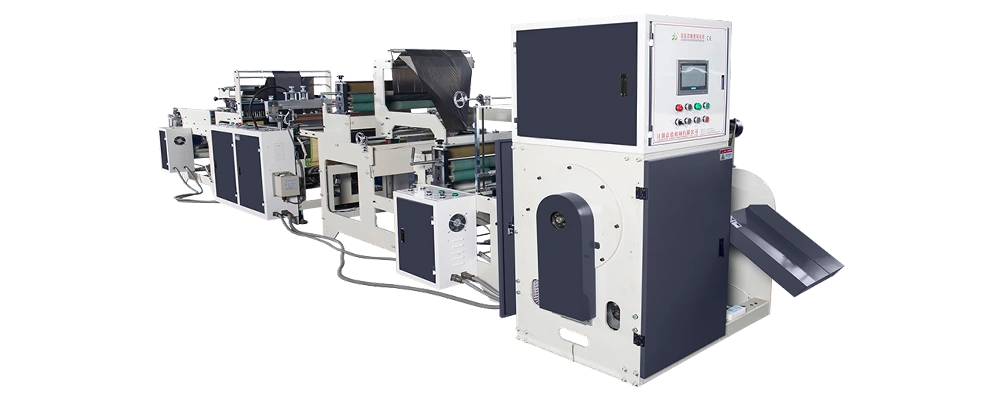
30 years leading professional manufacturer of bag-on-roll equipment in China
A packaging engineer at a mid-sized produce supplier recently shared a frustration that echoes across hundreds of packhouses: “Every morning, my crew spends 20 minutes untangling bundles of drawstring bags before the line can even start.” It sounds minor—until you calculate that 20 minutes a day, five days a week, adds up to over 80 lost production hours a year. And that’s just the untangling. Add the inconsistent bag opening, the random rejects due to torn drawstrings, and the operator fatigue, and the real cost of conventional loose drawstring bags becomes alarmingly high.
That’s exactly where the roll-fed alternative enters the picture. A drawstring bag on roll is not just the same bag in a different format—it’s a re-engineered packaging component that aligns with how modern automated lines actually run. For businesses scaling up their packing capacity, understanding the structure and benefits of this format has become a priority, not an afterthought.
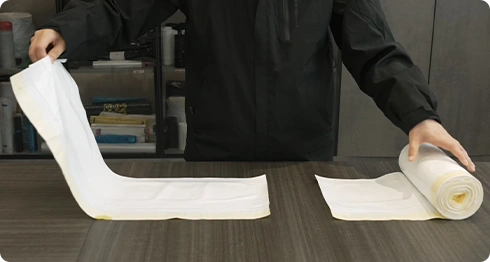
Think of a traditional box of drawstring bags as a deck of cards thrown loosely into a shoebox. Even when interleaved, they shift, stick together, and require constant manual intervention. A roll, by contrast, presents each bag in a controlled, repeatable position. The real structural difference is not just about winding bags onto a core—it lies in how the film, drawstring tape, and perforation are integrated during production.
On a high-performance converting line, the bags are formed continuously. Two layers of film are brought together, a folded or flat drawstring tape is inserted and heat-sealed along the mouth, and then a micro-perforation line is created between each bag unit. The critical innovation is that the perforation must be robust enough to hold the web together during unwinding and automatic filling, yet clean enough to tear with a precise snap when the bag is dispensed. This balance is far more delicate than it appears.
Because the drawstring tape runs longitudinally along the whole web, the roll format eliminates the individual loose string ends that cause snagging in bulk-feed systems. Instead, the user—or the automatic bagger—simply pulls the leading edge, the perforation breaks, and a perfectly oriented bag drops into position, drawstring ready. The cumulative effect on line efficiency can be dramatic. According to field observations shared at a European packaging automation forum, some packers reported a reduction in bag-related stoppages of over 40% after switching to roll-fed drawstring bags.
| Comparison Dimension | Loose Drawstring Bags (Standard Box) | Drawstring Bag on Roll |
|---|---|---|
| Feeding method | Manual pick-and-open; prone to misses | Continuous unwind; compatible with auto feeders |
| Changeover time | Frequent box changes; high operator dependency | Longer run time per roll; fewer interruptions |
| Storage footprint | Bulky boxes; air-entrained stacks | Compact, dense winding; easier warehousing |
| Consistency | Orientation varies; drawstring tucking may unfold | Orientation fixed; drawstring position guaranteed |
| Typical waste rate | 3–8% due to rejects and mis-picks (internal estimates) | Generally below 1.5% when perforation is well-tuned |
The numbers in the table are not marketing hype. They come from conversations with packaging line managers who have run both formats side by side. One senior technician at a large agricultural packing facility in Spain noted that the biggest surprise wasn’t the speed gain, but the drop in mechanical wear on their bag-opening station: fewer jagged motions meant fewer maintenance calls. When you dig into such operational details, the incentive to switch becomes concrete.
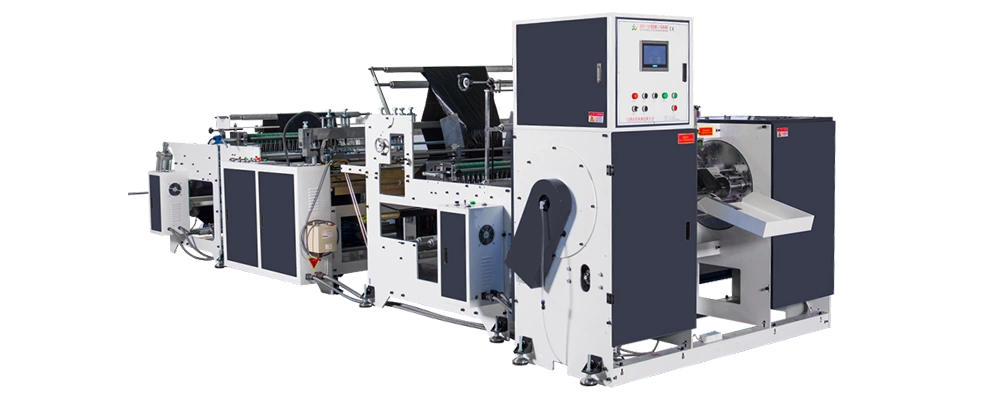
For those looking to produce these bags rather than just purchase them, the converting process demands a set of specific capabilities. The equipment must synchronize unwinding tension, drawstring insertion, and perforation with high precision. A modular system that allows independent adjustment of these functions can dramatically reduce setup scrap. Explore a production approach designed for this exact roll-fed structure if you are evaluating an in-house line.
To truly gauge whether a roll of drawstring bags will perform, you have to look past the surface and understand the functional anatomy that determines its behavior on the packaging floor.
Perforation design: The bond and cut pattern between bags is the single biggest reliability factor. A “tab-and-slot” micro-perforation style often outperforms simple dash patterns because it resists accidental web break during acceleration, yet still tears easily when pulled perpendicularly. When testing samples, request a tensile test on the perforation—ISO 527-3 provides a recognized framework for evaluating thin-film tensile characteristics, even if not specifically written for perforated webs.
Drawstring tape seal geometry: The seal that anchors the drawstring inside the bag mouth must behave with consistency. Bag failures during filling are frequently traced back to seal voids or edge weaknesses where the tape meets the side gusset. In a roll format, these potential weak points repeat predictably, so inspection systems can be positioned to catch them before shipping.
Core and winding tension: The cardboard core needs to withstand the torque of a high-speed untwist. Winding tension that is too low causes telescoping; too high causes blocking, especially with tacky film additives. Roll hardness testers (e.g., a Schmidt hammer-type tester, widely used in the film converting industry) provide a repeatable way to specify and verify winding quality.
Film surface slip properties: Coefficient of friction (COF) isn’t just a technicality. If the outer film is too slippery, the roll can shift during transport. Too tacky, and bags won’t separate cleanly at the perforation. Suppliers who can provide a COF certificate (dynamic, per ASTM D1894) give you a head start in line integration.
Making an informed choice about roll-fed bags—or the line that produces them—really comes down to these structural details. Without them, “on roll” is just a packaging gimmick. With them, it’s an engineering upgrade. Check out a system that puts precise control over perforation and tension where it matters most.
Moving from loose bags to a roll format isn’t only about line speed. The benefits compound in three areas that procurement and operations teams can measure directly.
Reduced labor dependency. A single unwind stand can feed a bagging cell for 40–60 minutes without operator intervention, compared to constant box topping-up. In regions with rising labor costs, this often becomes the fastest payback.
Fewer quality disputes from end-users. Retail chains and hospitals that receive products in drawstring bags complain when some bags are missing strings or are sealed shut. The roll format’s inherent consistency dramatically lowers such complaints. One corrugated packaging distributor serving the medical sector reported that customer quality notifications dropped by over 50% after their bag supplier switched to roll-based drawstring production—this was attributed to uniformity in drawstring placement.
Compatibility with sustainability targets. Rolls typically use less corrugated packaging per thousand bags compared to box-packed loose formats. Additionally, precise material tension control during converting can reduce film thickness variation, opening the door to down-gauging without compromising strength—a key lever for source reduction.
These aren’t theoretical gains. They appear in continuous improvement reviews and supplier scorecards, and they make the drawstring roll a quieter but more powerful contributor to cost reduction than many premium packaging innovations.
For operations that are not yet ready to invest in a full converting line but need reliable roll-fed bag supply, working with a converter who uses well-designed machinery becomes the logical step. When that investment does become viable, however, having the in-house capability changes the supply equation entirely. See how an integrated production workflow can support such a transition.
Even when the format is right, details still trip up users. These are the most frequent quality issues field engineers encounter, and what to ask about:
Perforation tear-out: If the web tears prematurely inside the automatic bag opener, the cause is almost always insufficient tear resistance parallel to the machine direction. A simple field test: hold the web with two hands 10 cm apart and snap it. It should remain intact until the perforation is bent at a sharp angle.
Drawstring pull-through: When the entire string comes out of the bag channel on opening, the seal bond between the tape and the inner film has likely degraded due to heat creep or insufficient dwell time during production. Demand process parameter logs from your supplier if this occurs.
Blocking in the roll: High ambient temperature during transport or storage can soften film additives that then cool and bond the bags together. Ask at what ambient temperature the roll was aged and tested; ideally, it should pass a 40°C/48-hour blocking simulation without difficulty.
Proactively testing incoming rolls against these failure modes requires no expensive lab—just a small set of standard procedures that can be run on the receiving dock. Many packhouses are integrating such tests into their quality gates, and the best bag converters welcome this because it proves their process stability.
The shift from loose drawstring bags to an on-roll format is not a trivial swap of packaging components. It represents a deliberate decision to align your packing line with higher repeatability, lower manual intervention, and a supply chain that delivers quality in a measurable form.
When you consider bringing production in-house, the focus inevitably turns to the converting equipment that will build those rolls. You’ll need a platform that gives you control over perforation geometry, continuous tape insertion, and tension management—without requiring a full-time process engineer to keep it running. Jiade has designed its roll-fed bag line specifically around those operator-friendly principles, incorporating independent servo-driven stations that allow recipe-based changeovers in minutes rather than hours. Factories that have implemented this architecture report that their scrap rate during startup dropped to nearly zero after the first week, a reflection of intuitive control, not just machine capability.
The right equipment doesn’t simply make bags; it makes the format genuinely reliable. Whether you’re currently sourcing rolls from a third party or planning your own production capacity, the structural advantages of the on-roll format only materialize when the converting process is under strict control. Visit the Jiade product page to explore the configuration that fits your output targets.
Disclaimer: Performance figures mentioned in this article are based on publicly shared industry benchmarks and user-reported experiences; actual results vary depending on film materials, line conditions, and operational practices. Always validate specifications against your specific production environment.



.webp)