30 years leading professional manufacturer of bag-on-roll equipment in China
A customer asks for drawstring garbage bags—convenient, easy to tie, clean to handle. Another insists on star seal—stronger bottom, better for wet waste. Both are premium products compared to standard flat-seal bags. Both require different machine configurations.
If you produce garbage bags on roll, you have likely encountered this question: Should you invest in a drawstring bag machine or a star seal bag maker? The answer depends not on which is “better,” but on which matches your customers' waste profiles and your production economics.
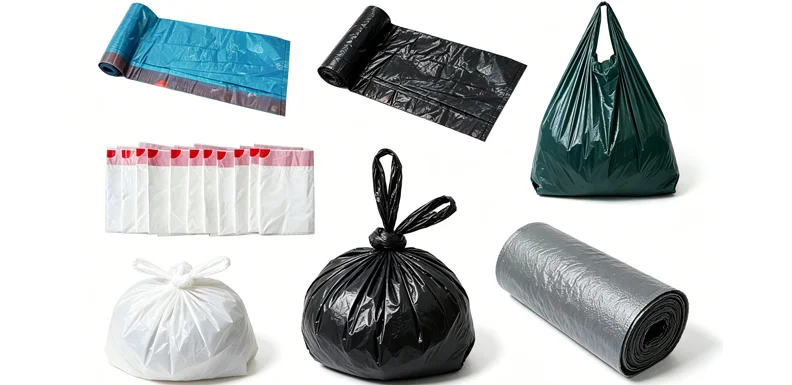
This article compares drawstring and star seal roll bag machines across three dimensions: end-user performance, production requirements, and material efficiency. It then maps each machine type to specific order profiles, helping you decide which fits your business.
The choice between a drawstring bag machine and a star seal bag maker starts with understanding how the two bag types differ structurally—and what that means for the end user.
| Feature | Drawstring Bag | Star Seal Bag |
|---|---|---|
| Bottom seal design | Typically flat seal (straight seam across bottom) | Star-shaped pattern with film gathered and sealed, creating multiple fold lines |
| Top closure | Built-in drawstring cord along reinforced rim | Standard open top; requires manual tying |
| Load distribution | Stress concentrates at bottom corners | Weight distributes evenly across bottom |
| Leak resistance | Can leak at corners under pressure | High; eliminates sharp corners where liquids collect |
| Ease of use | Easy to close, carry, dispose; cleaner handling | Easier to tie than flat seal, but requires manual closure |
| Primary applications | Household trash, offices, restrooms, light retail | Heavy waste, wet waste, restaurants, warehouses, healthcare |
| Per-unit cost | Highest (due to drawstring cord and hem) | Moderate (slightly above flat seal) |
What this means for your product line: Drawstring bags excel in convenience and hygiene—users can close and carry bags without touching the waste. Star seal bags excel in strength and leak resistance—they conform to container shapes and distribute weight evenly. The difference is not cosmetic; it is structural and operational.
According to industry analysis, star seal bags often use less plastic to achieve equal or better performance than flat-seal designs, while drawstring bags offer premium convenience for hygiene-sensitive environments.
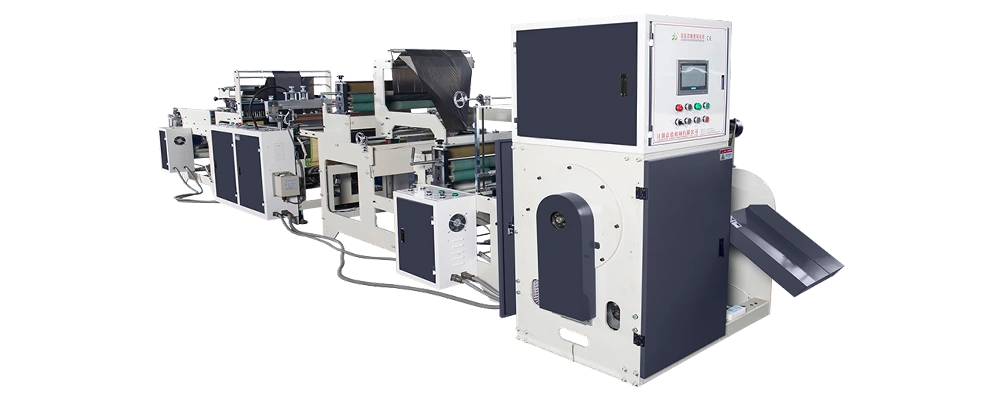
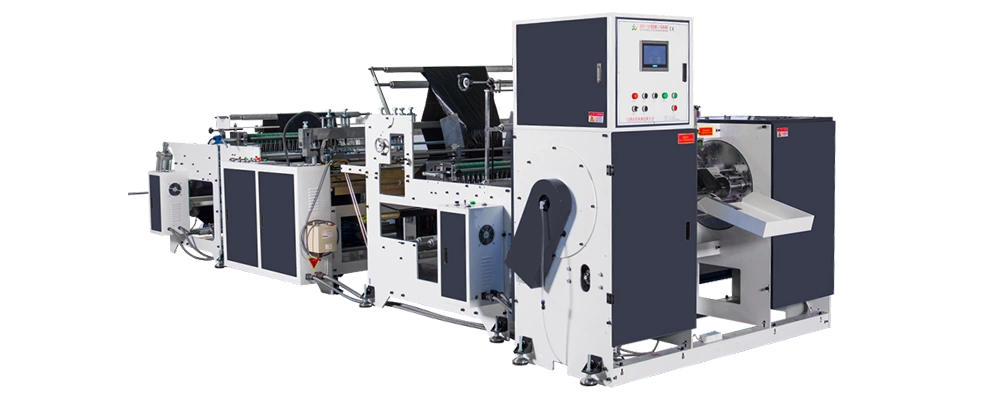
For converters producing garbage bags on roll, the machine platform must support the specific sealing and forming requirements of each bag type. See the technical overview of bag on roll making machines with Delta-integrated control and quick-change capability.
Producing drawstring bags and star seal bags requires different machine capabilities. Understanding these differences helps you evaluate whether your current line—or a new investment—can support each format.
Drawstring bag machines: Must insert a drawstring cord into the top hem during the bag-making process. This requires additional feeding stations for the cord material and precise positioning to ensure the drawstring pulls smoothly. The machine seals the hem around the cord without damaging it.
Star seal bag machines: Must gather and fold the film at the bottom into a star-shaped pattern before sealing. This requires a gathering station that creates uniform folds across the bag width. The machine then seals the gathered film under controlled pressure and temperature.
Production implication: Drawstring machines have more moving parts and material inputs (film + cord). Star seal machines require precise mechanical gathering but no additional material.
Both machine types can run HDPE, LDPE, recycled materials, and biodegradable plastics. However, thickness requirements differ:
| Material Type | Drawstring Bag Machines | Star Seal Bag Machines |
|---|---|---|
| HDPE thickness range | 0.006–0.04mm | 0.006–0.025mm |
| LDPE thickness range | 0.015–0.05mm | Similar range; star seal can use thinner film for equivalent strength |
| Recycled content | Compatible | Compatible |
| Biodegradable materials | Supported | Supported |
Star seal bags can often achieve high strength with thinner film because the gathered design distributes stress more evenly. Drawstring bags may require thicker film to compensate for flat bottom stress, depending on the bottom seal configuration.
Production speed varies by machine configuration and bag type:
Drawstring bag machines: High-speed overlap drawstring machines can achieve significant output with double servo motor control feeding and automatic roll changing. The additional drawstring insertion step may affect maximum speed compared to simpler bag types.
Star seal bag machines: Automatic star seal bag on roll making machines can operate at 60–190 pieces per minute × 2 lines for U-type and S-type bags, and 60–140 pieces per minute × 2 lines for T-shirt bags.
Production implication: Star seal machines typically achieve higher output for garbage roll applications due to simpler forming mechanics. Drawstring machines offer premium product differentiation at slightly lower throughput.
For converters serving the garbage bag market where both drawstring and star seal options are common, see the garbage bag machine line for application-specific configurations and material compatibility details.
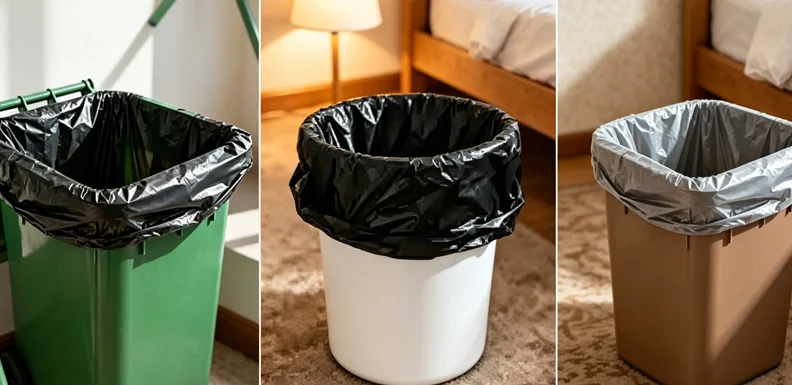
Below are three common packaging converter order patterns. Identify yours, then follow the recommendation.
Typical orders: Drawstring bags for offices, restrooms, nail salons, light retail
Customer priority: Convenience, clean handling, easy closure
Waste type: Dry, light to moderate weight; minimal liquids
Recommendation: Drawstring bag machine — the convenience premium justifies higher per-unit cost for customers who value hygiene and ease of use
Typical orders: Star seal bags for restaurants, warehouses, commercial kitchens, healthcare
Customer priority: Strength, leak resistance, load capacity
Waste type: Wet, heavy, irregular loads with risk of leakage
Recommendation: Star seal bag maker — the structural advantage of even weight distribution and leak resistance is critical. Star seal bags often outperform flat-bottom designs under weight
Typical orders: Some customers want drawstring convenience; others need star seal strength
Priority: Flexibility to produce both formats without duplicating capital investment
Recommendation: Evaluate modular machine platforms that support both drawstring and star seal production through interchangeable tooling. Consider production volume for each format before committing to dedicated lines
Star seal bags are often more economical for high-volume operations because they use less material per bag and have lower per-unit cost. Drawstring bags, while higher in cost, serve markets where convenience and hygiene justify the premium.
Use this checklist during your internal evaluation. The key is quantifying actual customer demand and waste profiles before investing in new equipment.
Why: End-use determines seal requirement. Dry/light waste → drawstring may suffice. Wet/heavy waste → star seal is likely required.
How to document: Ask each of your top 10 customers: “What percentage of your waste is wet or heavy? Do you currently experience leaks or bag failures?”
Why: Drawstring bags cost more per unit. Star seal bags cost moderately more than flat seal. Your pricing must cover the additional production cost.
How to document: Survey customers: “Would you pay a 5-10% premium for drawstring convenience? For star seal strength?”
Why: Star seal bags can use thinner film for equivalent strength, potentially reducing material cost. Drawstring bags require additional cord material.
How to document: Calculate material cost per 1,000 bags for each format at your target thickness.
Why: Switching between drawstring and star seal production requires different tooling and setup. Frequent changeovers reduce effective output.
How to document: Measure current changeover time. Multiply by estimated weekly format switches to calculate downtime cost.
Why: Dedicated machines require sufficient volume to justify investment. Modular platforms may serve both formats with lower capital cost.
How to document: Speak with your top 5 customers. Ask: “What annual volume of drawstring bags would you order? Of star seal bags?”
Once you have documented the five steps above — especially customer waste profiles, willingness to pay, and volume projections — you can translate your order mix into specific machine requirements.
| If your order profile looks like… | Then consider… | Key machine features to verify |
|---|---|---|
| Household/office waste, convenience-focused customers | Drawstring bag machine | Drawstring insertion accuracy, double servo control feeding, automatic roll changing |
| Restaurant/warehouse/healthcare, heavy/wet waste | Star seal bag maker | Precision gathering station, consistent seal formation, high output capacity |
| Mixed portfolio with sufficient volume for both | Separate dedicated lines | Each line optimized for its format; minimal changeover required |
| Mixed portfolio with moderate volume for each | Modular convertible platform | Quick-change tooling, recipe storage for different formats, Delta-integrated control |
For converters planning to serve both convenience-driven and strength-driven garbage bag customers, modern roll bag platforms with a modular design may support both drawstring and star seal production on the same base machine, reducing capital expenditure while maintaining production flexibility.
The following topics extend the drawstring vs star seal comparison into related equipment and material decisions:
Material Selection for High‑Speed Roll Bag Lines
Sealing and Cooling in Roll Bag Production
Quick Changeover Methods for Bag on Roll Machines



.webp)