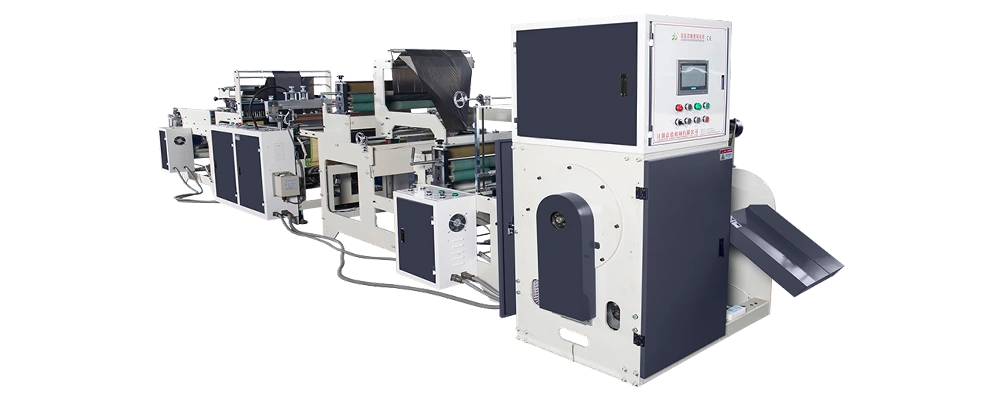
30 years leading professional manufacturer of bag-on-roll equipment in China
A customer asks for “heavy-duty” garbage bags. Another specifies “80-gauge” produce bags. A third simply says “standard thickness.” These descriptions mean different things to different suppliers — and the wrong interpretation can mean bags that leak, tear, or cost too much.
Film thickness is one of the most critical specifications in roll bag production. It determines strength, cost, flexibility, and how the bag performs in the end-user's hands. Yet the terminology — micron, mil, gauge, GSM — varies by region, material type, and application.
This guide explains the units used to measure roll bag film thickness, provides recommended thickness ranges for common applications, and helps you match film thickness to your production equipment and customer requirements.
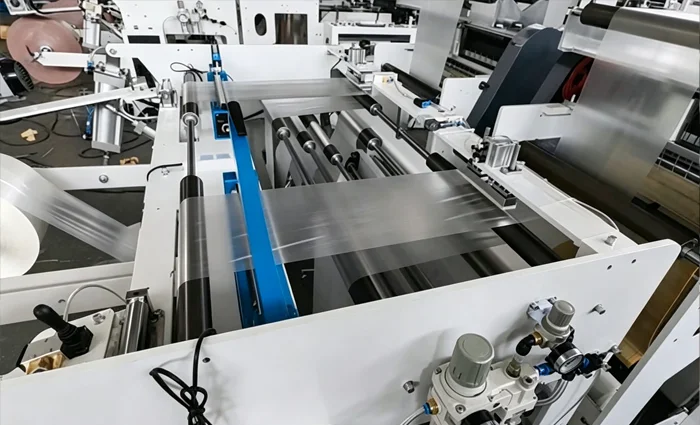
Different regions and industries use different units to measure plastic film thickness. Understanding these units and how to convert between them is essential for specifying the right film for your roll bags.
The three common units:
| Unit | Definition | Common In | Conversion |
|---|---|---|---|
| Micron (μm) | 1/1000 of a millimeter | Europe, Asia, global packaging | 1 micron = 0.0394 mil |
| Mil | 1/1000 of an inch (0.001″) | United States | 1 mil = 25.4 microns |
| Gauge | Approximately 0.254 microns | US film industry | 100 gauge ≈ 25.4 microns |
Important distinction: Gauge is not a standardized measurement. Always confirm the actual thickness with your supplier. Higher numbers mean thicker film, regardless of the unit.
Quick conversion formulas:
Micron = Mil × 25.4
Mil = Micron × 0.0394
Gauge = Mil × 100
Gauge = Micron × 3.937
Micron = Gauge × 0.254
Quick reference table:
| Mil | Micron (μm) | Gauge |
|---|---|---|
| 0.5 | 12.7 | 50 |
| 0.75 | 19.1 | 75 |
| 1.0 | 25.4 | 100 |
| 1.5 | 38.1 | 150 |
| 2.0 | 50.8 | 200 |
| 2.5 | 63.5 | 250 |
| 3.0 | 76.2 | 300 |
| 4.0 | 101.6 | 400 |
What about GSM? GSM (grams per square meter) measures film weight per area, not thickness. While GSM can indicate density, it is not a direct thickness measurement and varies by material type. For roll bag specifications, micron, mil, or gauge are the standard units.
Understanding film thickness is only part of the equation — different bag on roll machine series handle different thickness ranges. See how bag on roll making machines are configured for various film gauges.
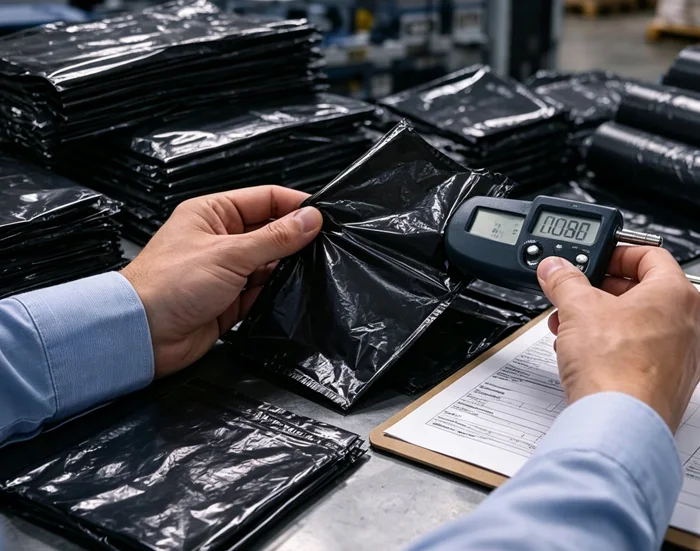
Different bag applications require different thicknesses. The table below provides general guidelines for common roll bag types.
| Application | Typical Thickness Range | Unit | Material Notes |
|---|---|---|---|
| Thin produce bags | 8–15 | microns | HDPE or LDPE; single-use |
| Retail shopping bags | 20–40 | microns | HDPE for stiffness; LDPE for flexibility |
| Standard kitchen trash (13 gal) | 0.9–1.5 | mil (23–38 microns) | LLDPE blend for balance of strength and flexibility |
| Light-duty commercial waste | 0.7–1.0 | mil (18–25 microns) | Suitable for paper and office debris |
| Medium-duty commercial | 1.1–1.5 | mil (28–38 microns) | All-purpose for mixed waste |
| Heavy-duty/contractor grade | 3.0+ | mil (76+ microns) | For sharp or heavy loads |
| Food packaging film | 20–80 | microns | Barrier films; varies by material |
| Industrial/mattress packaging | 100–200 | microns | High puncture resistance |
Important note: Thinner films made from higher-quality virgin resin can outperform thicker films made from lower-quality recycled material. Material type — HDPE, LDPE, LLDPE, or blends — matters as much as thickness.
Different polyethylene resins have different strength characteristics at the same thickness. Understanding this helps you select the right thickness for each application.
HDPE (High-Density Polyethylene):
Produces stiffer, thinner-feeling bags
Stronger and more durable than ordinary PE of the same thickness — up to three times stronger
Requires 2/3 less petroleum-based raw material
Best for lightweight trash, retail shopping bags, and produce bags
Can tear easily if punctured
Thickness typically measured in microns
LDPE (Low-Density Polyethylene):
Softer, smoother feel
More flexible
Better puncture resistance than HDPE at same thickness
Best for heavy-duty applications where tear resistance matters
Thickness range: 0.5 mil to 40 mil
LLDPE (Linear Low-Density Polyethylene):
Most widely used can liner type today
Highly puncture-resistant and tear-resistant
Can achieve the same strength as LDPE at significantly thinner gauges
Best for multi-purpose applications
The practical takeaway: A 1.0 mil LLDPE bag may outperform a 1.5 mil LDPE bag in puncture resistance. When specifying thickness, always consider the material type, not just the number.
Thickness is not just about end-use performance — it also affects production economics and machine operation.
Impact on cost and sustainability:
Thicker films increase material cost per bag
Thicker films increase shipping weight
Thinner films generally reduce plastic usage and waste
Impact on machine operation:
Thicker films require higher sealing temperatures and longer dwell times
Thinner films require more precise tension control to prevent breakage
Machines with servo-driven tension control handle a wider thickness range reliably
Quick-change tooling and recipe storage allow faster switching between thicknesses
Impact on roll quality:
Thicker films wind more easily but produce heavier rolls
Thinner films require precise tension control to prevent telescoping
Winding consistency depends on both film thickness and machine capability
Industry guidelines suggest using the thinnest film that still secures the load safely, remembering that film type and quality matter just as much as thickness.
Use this checklist to specify the correct film thickness for your production and customer requirements.
Step 1 — Identify the end-use application and waste type
Why: Different waste types require different strength levels. Dry paper waste needs less strength than wet food waste or sharp objects.
How to document: Ask your customer: “What type of waste will these bags hold? Is it wet, heavy, or sharp?”
Step 2 — Choose the right material type first
Why: Material type affects strength more than thickness alone. LLDPE can achieve the same strength as LDPE at thinner gauges.
How to document: Match material to application: HDPE for lightweight/retail, LLDPE for general-purpose strength, LDPE for heavy-duty flexibility.
Step 3 — Select thickness based on load requirements
Why: Higher loads require thicker film or stronger material.
How to document:
Light duty (paper, office waste): 0.7–1.0 mil (18–25 microns)
Medium duty (mixed waste): 1.1–1.5 mil (28–38 microns)
Heavy duty (sharp or wet waste): 1.5–3.0+ mil (38–76+ microns)
Step 4 — Verify machine compatibility
Why: Not all bag on roll machines handle all thicknesses equally. Verify the machine's thickness range.
How to document: Check the machine specifications for minimum and maximum film thickness. If running thin films (below 15 microns), ensure servo tension control is available.
Step 5 — Test and validate with sample rolls
Why: Film behavior on the machine is the ultimate proof. What works in theory may not work on your production floor.
How to document: Run a test batch at your target thickness and material. Inspect seals, roll quality, and perforation performance.
For converters producing garbage bags, thickness selection varies by bag type — drawstring, star seal, and C-fold bags each have different thickness requirements. See the garbage bag machine line for application-specific configurations.
Mistake 1 — Assuming higher thickness always means better quality: Thicker film is not always better. A high-quality LLDPE bag at 1.0 mil can outperform a low-quality LDPE bag at 1.5 mil. Material type and manufacturing quality matter.
Mistake 2 — Confusing gauge with standardized measurement: Gauge is not a standardized unit. Always confirm the actual micron or mil thickness with your supplier. A “100-gauge” bag from one supplier may differ from another.
Mistake 3 — Ignoring material type when specifying thickness: HDPE, LDPE, and LLDPE have different strength characteristics at the same thickness. Specify both material and thickness.
Mistake 4 — Not matching thickness to machine capability: A machine rated for 10–100 microns cannot run 150-micron film. Verify machine specifications before ordering film.
Mistake 5 — Overlooking the impact of recycled content: Recycled content can affect film strength at a given thickness. Thinner bags made with recycled material may not perform as well as virgin material bags of the same thickness.
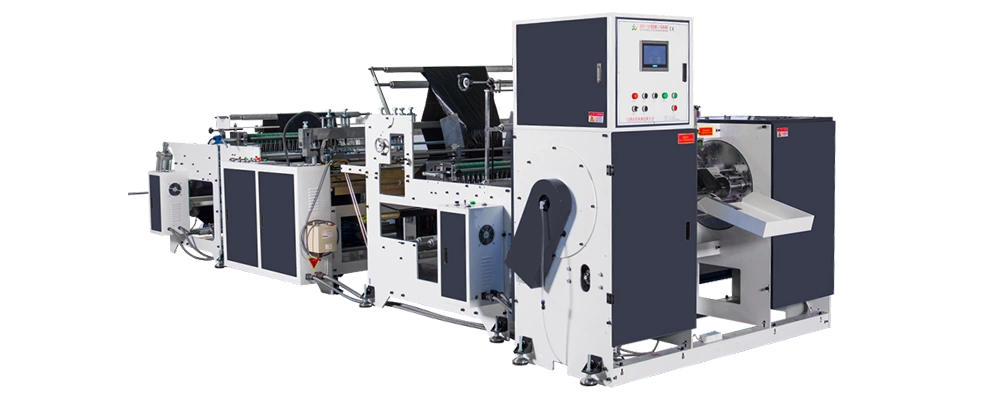
Once you have determined the film thickness range for your roll bag production, the next step is ensuring your bag on roll machine is configured to handle that range reliably.
Key machine features for thickness flexibility:
Servo-driven tension control — Essential for thin films (below 20 microns) to prevent breakage
Wide sealing temperature range — Thicker films require higher temperatures
Recipe storage — Save settings for different thicknesses and materials
Quick-change tooling — Reduce downtime when switching between thin and thick films
Cooling zone length — Thicker films require more cooling time before winding
The following topics are directly related to film thickness selection and its impact on roll bag production:
How PE Resin Type (HDPE, LDPE, LLDPE) Affects Strength at the Same Thickness
Film Thickness Tolerance and Its Impact on Seal Quality and Winding Consistency
Recycled Content vs Film Thickness: Trade‑offs in Strength and Machinability
Thickness Measurement Methods for Roll Bag Film — Micron, Mil, and ASTM Standards
Adjusting Sealing Temperature and Cooling Time for Different Film Thicknesses




.webp)